

The most popular advice on Claude vs Perplexity is also the least useful: use Perplexity for research and Claude for writing. That split is directionally right, but it leaves out the decisions that determine whether an SEO article is accurate, distinctive, and commercially useful. The better question isn't which tool wins. It's where each tool should enter your workflow, what information it should receive, and when you should stop trusting its output.
Claude and Perplexity solve different problems. Perplexity is designed around live web retrieval and visible citations. Claude is better suited to sustained reasoning, synthesis, drafting, and revision. Treating them as interchangeable forces one tool to perform work the other handles more naturally.
That distinction matters for affiliate marketers. A product comparison needs current source material, but it also needs a coherent argument, useful buying guidance, and copy that doesn't sound like a stitched-together search result. The strongest process gives each stage to the tool built for it.
Why the Claude vs Perplexity Debate Misses the Point
Most comparison articles turn Claude and Perplexity into direct rivals. That framing is convenient for a headline, but it breaks down as soon as you produce content regularly. A research engine and a reasoning assistant can appear similar in a browser tab while contributing very different value to an editorial pipeline.
Perplexity's advantage is retrieval with verification. It searches the web by default and places numbered citations beside its answers, which makes it useful for finding current pages, checking claims, and collecting source material. Claude's advantage is working through material you give it. It can organize a large research packet, identify relationships between ideas, develop an argument, and turn rough notes into readable long-form copy. Independent comparisons make the same distinction, positioning Perplexity for source-finding and Claude for deep analysis and drafting (independent comparison of Perplexity and Claude).
The mistake is choosing one tool before defining the job.
The workflow allocation test
Ask four questions before opening either platform:
- Does the task depend on fresh information? Use Perplexity first.
- Does the task require interpretation or structure? Hand the material to Claude.
- Will a reader need to verify the claim? Preserve the original source, not just the AI summary.
- Does the output represent your brand? Edit the final language yourself.
This model also explains why adoption patterns don't point to a single winner. Claude launched in March 2023 and reached an estimated 18.9 million monthly active users worldwide by early 2025, including 2.9 million monthly active app users and 16 million unique website visitors in January 2025, after website usage peaked at 18.8 million in November 2024 (Claude user estimates). Perplexity launched in December 2022 and was estimated at 30 million monthly active users in April 2025 for its core product. A separate estimate reports 780 million search queries in May 2025 and growth above 20% month over month (Perplexity usage statistics).
Those figures describe different kinds of demand. Claude's growth reflects broad assistant use across writing, reasoning, and other tasks. Perplexity's usage is tied more closely to discovery and search behavior. Neither number proves that one tool produces better content.
Practical rule: Choose the tool that reduces the biggest risk in the current stage, not the tool with the broadest feature list.
For a solo publisher, the practical answer is often a sequence: discover and verify with Perplexity, then interpret and write with Claude. The choice isn't Claude or Perplexity. It's Perplexity, then Claude, with human review between them.
Core Capabilities and How Each Tool Works
Claude and Perplexity may both answer prompts, but their default behavior creates different working styles. Perplexity starts by looking outward. Claude generally starts with the prompt, files, and context already in the conversation.
Claude is strongest when the task has multiple constraints. Give it a detailed brief, source excerpts, a target reader, an editorial voice, and a required structure, and it can hold those pieces together while drafting or revising. Its value comes from long-context synthesis, conversational depth, nuanced writing, and multi-step reasoning.
Perplexity is strongest when the answer depends on the current web. It searches sources as part of the response and shows inline numbered citations, making it easier to inspect where a claim came from. That makes it particularly useful for competitor research, recent product changes, market discovery, and source collection.
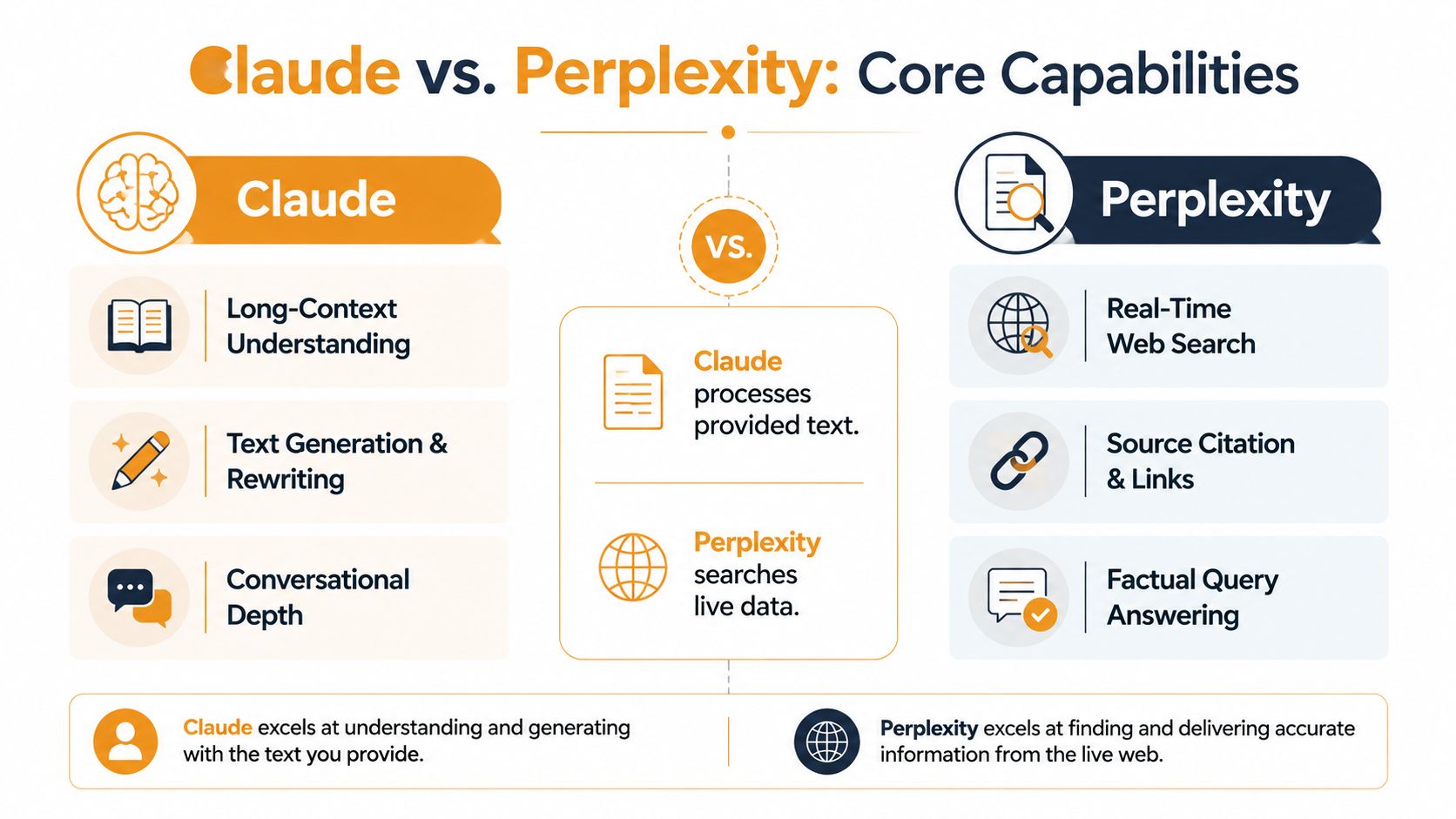
Claude vs Perplexity Core Capabilities
| Feature | Claude | Perplexity |
|---|---|---|
| Primary role | Reasoning, synthesis, writing, and complex task support | Live web research and cited answers |
| Information behavior | Processes the material and instructions provided in context | Searches current web sources by default |
| Best content use | Briefs, outlines, drafts, rewrites, and editorial analysis | Research dossiers, fact discovery, and source finding |
| Citation experience | Citations require supplied sources or manual verification | Inline numbered citations are built into answers |
| Writing style | More capable of sustained, nuanced long-form drafting | Useful for functional answers and research summaries |
| Main failure risk | Coherent claims may still need source verification | Cited answers can still require checking for source quality and context |
That difference is more important than interface polish. If you ask Perplexity to write a polished affiliate review, it may produce a serviceable draft, but the prose can feel compressed around search findings. If you ask Claude for current market facts without providing sources, it may produce a persuasive answer whose factual foundation still needs checking.
You can browse the Perplexity tool to see how a research-first interface fits into your own process. For a broader comparison of reasoning assistants, the discussion of Claude versus OpenAI is useful because it reinforces a point that applies here: model selection should follow the task, not brand loyalty.
What each tool should own
Assign Perplexity the work that benefits from breadth and freshness:
- finding relevant pages and primary documentation
- locating current product information
- comparing multiple viewpoints
- building a citation-backed research file
- identifying claims that need verification
Assign Claude the work that benefits from continuity and judgment:
- turning research into a search-intent-led outline
- grouping evidence into themes
- drafting explanations for a defined audience
- rewriting generic passages into a consistent voice
- reviewing logic, transitions, and content gaps
Neither tool removes editorial responsibility. Perplexity can show sources without proving that every citation supports the sentence you wrote. Claude can produce elegant prose without guaranteeing that every detail is current.
Accuracy and Hallucination Behavior in SEO Content
AI-generated content fails in predictable ways. The most dangerous errors aren't always absurd statements. They're plausible details that sound precise enough to publish, such as an outdated feature, an invented limitation, a misread product policy, or a quotation assigned to the wrong source.
Perplexity gives researchers a useful advantage because it exposes a verification trail. Its built-in web search and inline citations make it faster to open the underlying page and inspect the evidence. That doesn't make the output automatically correct. A citation may support only part of a sentence, point to a secondary summary, or contain information that no longer matches the product page.
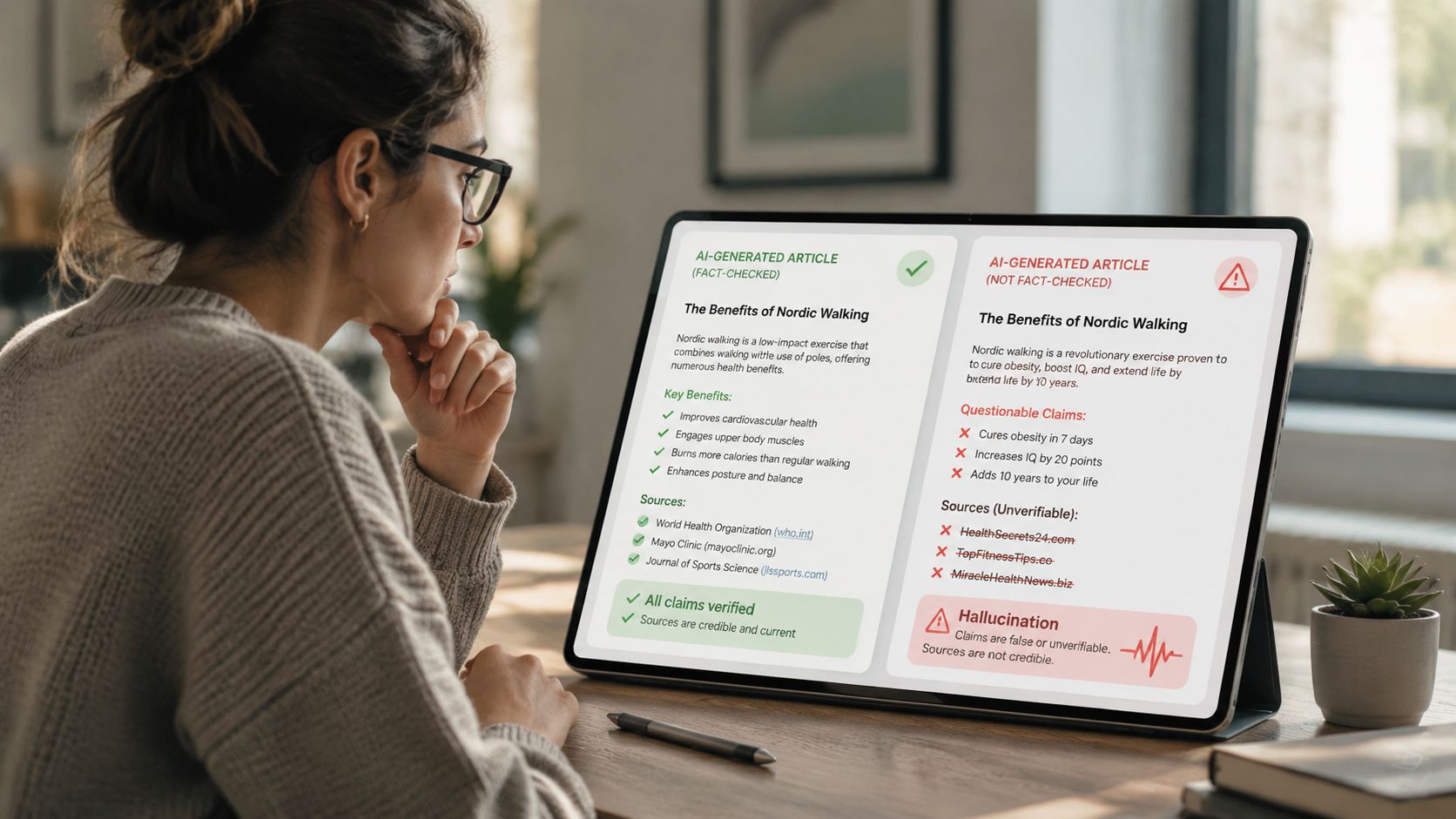
Claude creates a different risk profile. It can reason through supplied source material and produce a more coherent explanation, but it generally won't provide a default live-search citation trail in the same research-first manner. Its fluent prose can hide unsupported assumptions, especially when a prompt asks for statistics, case studies, product specifications, or attributed claims without attaching source documents.
A verification workflow that survives publication
Use Perplexity to collect evidence, then separate source facts from AI interpretation before drafting. A simple research record should include the claim, the exact source page, the relevant passage, the date you checked it, and any qualification the source makes.
Then give Claude the verified material with strict boundaries:
Source control: Write only from the supplied evidence. If the material doesn't support a claim, mark it for review instead of filling the gap.
That prompt prevents a common handoff failure. Without it, Claude may connect two nearby facts into a conclusion that neither source makes. After drafting, return to the original pages and check every commercially important assertion, particularly pricing, availability, integrations, guarantees, and product limitations.
Common failure modes
- Citation laundering: A cited page appears beside a sentence, but the page supports only a related point.
- Date drift: A once-accurate feature or policy remains in the draft after the source has changed.
- Specification invention: The model supplies a precise technical detail because the prompt implies one should exist.
- Quote contamination: A summary is rewritten as if it were a direct quotation.
- Source substitution: A secondary article replaces the primary product documentation without warning.
For additional workflow ideas, AI tools for SEO in 2026 provides useful context around selecting tools for research and optimization. The important operational principle is simple: Perplexity speeds up discovery, Claude improves synthesis, and neither replaces source-level review.
Output Quality for Affiliate and SEO Content Tasks
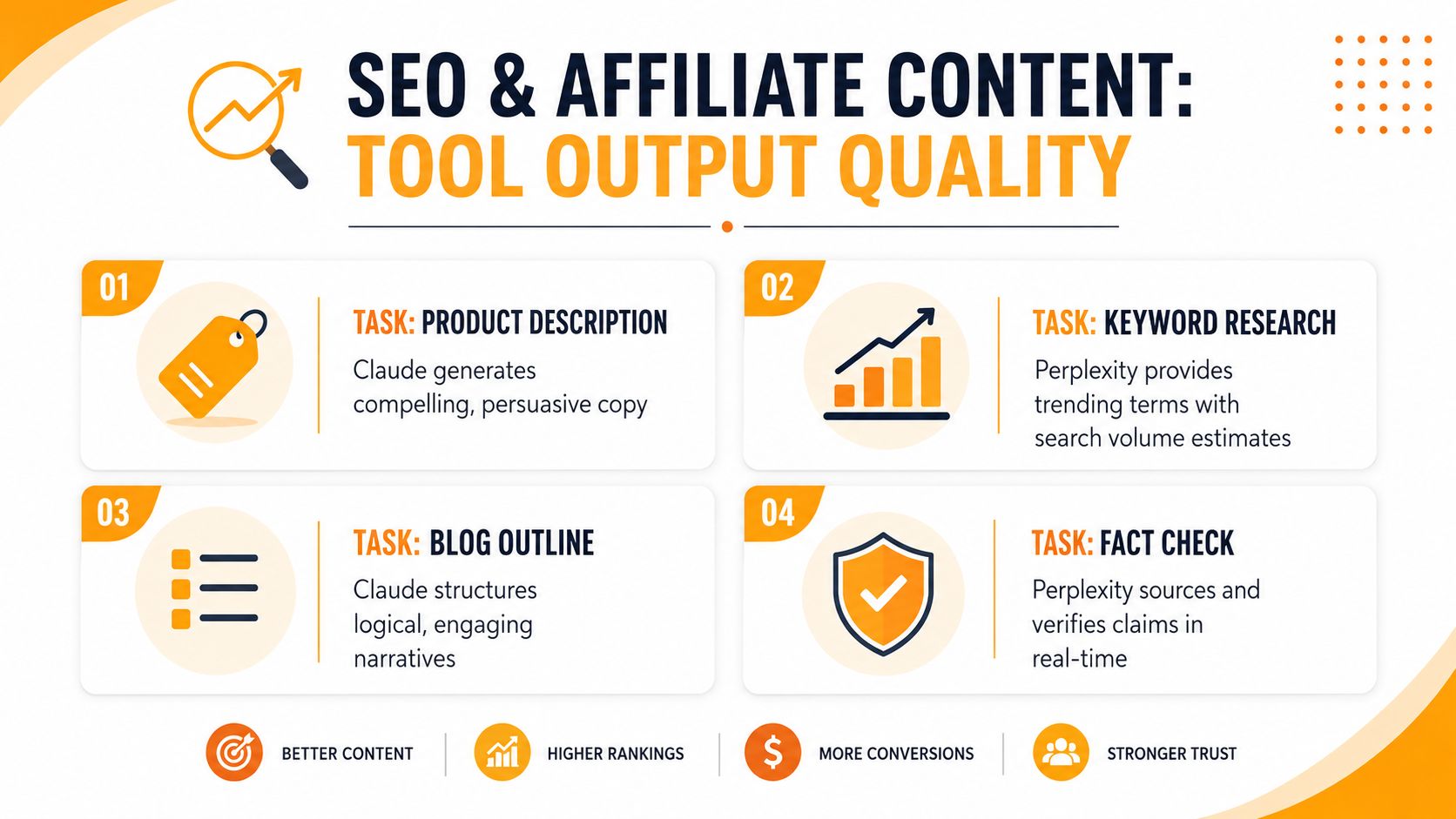
Output quality depends less on which model sounds more impressive and more on whether the prompt matches the job. Affiliate content usually needs several layers at once: accurate product facts, clear search intent, persuasive but restrained recommendations, useful comparisons, and an editorial voice that doesn't resemble generic AI copy.
Claude tends to perform better after the evidence and editorial constraints are already assembled. Perplexity tends to perform better before that point, when you need to discover what the evidence is.
Product reviews and comparison pages
Start with Perplexity for questions such as:
Find the official product page, documentation, support policy, and reputable independent reviews for [product]. Separate confirmed features from reviewer observations. Link each claim to its source and flag contradictions.
Don't ask it to decide the final verdict immediately. First collect the facts and disagreements. That gives you material that Claude can evaluate rather than a conclusion it has already packaged.
Then use Claude with a controlled drafting prompt:
Using only the research dossier below, create a review for [audience]. Explain who the product suits, who should avoid it, and how it compares with [alternative]. Do not invent specifications, prices, quotes, or performance claims. Mark unsupported points as editorial questions.
Claude's strength appears in the resulting structure. It can turn scattered evidence into a buying argument, distinguish features from outcomes, and keep the recommendation connected to the reader's situation. Perplexity's raw draft may be more current, but it often needs heavier editing to achieve a persuasive, human rhythm.
Briefs and informational articles
For an SEO brief, Perplexity can identify recurring questions, current terminology, and source pages worth studying. Claude can then organize those findings into:
- Search intent: the problem the reader is trying to solve
- Content promise: what the article should answer clearly
- Heading logic: a sequence that moves from definition to evaluation to action
- Evidence plan: which claims need citations or primary documentation
- Conversion path: where a relevant recommendation belongs without interrupting usefulness
For long-form informational content, ask Claude to create the outline before drafting. Include the audience, prohibited claims, internal links, source material, tone, and desired conclusion. It follows complex editorial instructions more reliably when the prompt treats those requirements as a working brief rather than a loose list of keywords.
The comparison of Claude Pro and ChatGPT for writing offers another useful reference point for judging writing output. The broader lesson is that keyword insertion isn't a substitute for editorial structure. A page can mention the target phrase naturally and still fail if it doesn't answer the reader's decision.
What doesn't work
Avoid asking either tool to “write a complete SEO article” from a single topic phrase. That prompt encourages generic headings, unsupported details, repetitive introductions, and conclusions that don't reflect the evidence. Break the work into research, argument, drafting, verification, and editing.
Building a Hybrid Workflow with Both Tools
A reliable Claude and Perplexity workflow is a chain of handoffs, not a simultaneous free-for-all. Each handoff should transfer a defined artifact, such as a source list, research dossier, outline, draft, or fact-check log. Passing vague conversation history between tabs makes citation integrity harder to maintain.
A five-stage content pipeline
Research with Perplexity. Define the question narrowly and request primary sources first. Ask for competing evidence, unresolved claims, and links beside each finding. Save the pages yourself because the final article should rely on the source, not merely on Perplexity's summary.
Synthesize with Claude. Paste the research dossier into Claude and ask it to cluster findings by reader question. Have it separate confirmed facts, reasonable interpretation, and open questions. Claude adds value by identifying the argument the sources can support.
Draft with Claude. Supply the approved outline, audience, voice rules, affiliate disclosure requirements, and source boundaries. Request a draft that uses citations or source markers exactly where verification is needed. Don't let the model hide uncertain claims inside polished paragraphs.
Fact-check with Perplexity. Return to Perplexity with a list of every time-sensitive or externally verifiable claim. Ask it to locate current supporting pages and identify statements that no longer hold. This second pass is different from initial research because it audits the draft rather than explores the topic broadly.
Edit and publish. Use Claude for a final coherence pass, but keep factual changes tied to the verification log. A human editor should decide whether the evidence justifies the recommendation, whether the affiliate angle is disclosed clearly, and whether the article gives readers enough information to act.
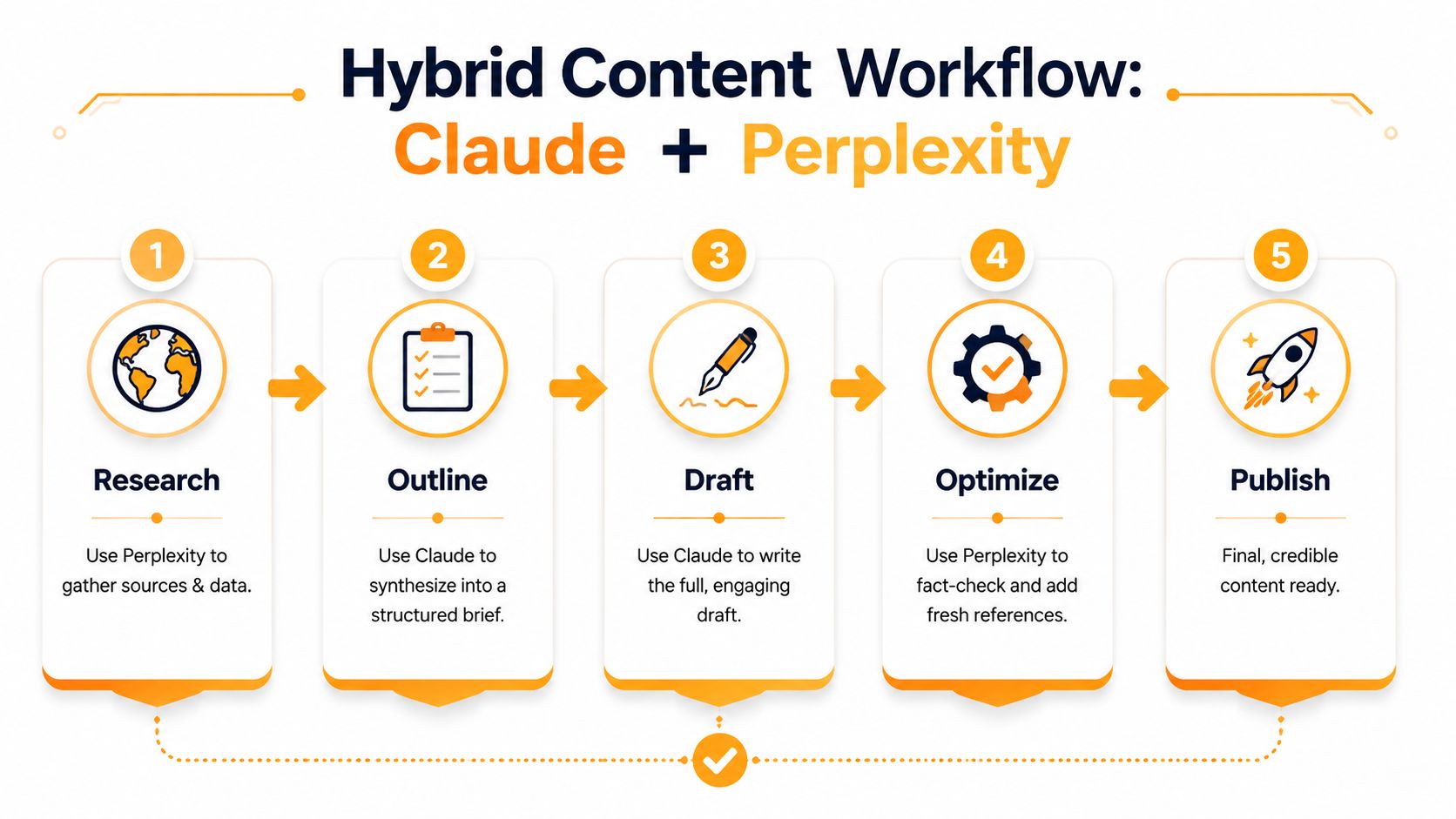
Protecting the handoff
Don't paste an unstructured browser dump into Claude. Remove duplicated pages, label each source, distinguish direct observations from claims, and retain the URL beside the relevant note. If the dossier is large, send it in labeled batches and ask Claude to maintain a source index.
A useful handoff format looks like this:
- Claim: the statement you may publish
- Evidence: the source passage in your own notes
- Qualification: limits, dates, or conditions
- Editorial use: review, comparison, tutorial, or background
- Status: verified, disputed, or needs review
The handoff is where quality is won or lost. A strong model can't repair a research packet that mixes verified facts with guesses.
The 10 best LLM SEO tools can help you evaluate adjacent tools, but the central workflow remains the same. Perplexity gathers and challenges evidence. Claude gives that evidence shape. Your editorial process decides what deserves publication.
Pricing and Plan Comparison for Content Teams
Pricing changes, plan availability changes, and feature access can vary by region or account type. That makes current plan pages more trustworthy than old comparison articles. Treat the table below as a decision framework rather than a permanent price sheet, and verify the live offer before purchasing.
| Plan | Claude | Perplexity |
|---|---|---|
| Free access | Suitable for testing core conversations and basic workflows, with usage limits | Suitable for testing search and citation workflows, with usage limits |
| Individual paid access | Designed for heavier use, larger projects, and expanded capabilities | Designed for higher research usage and broader access to research features |
| Team or organizational access | Better suited to shared work, administration, and controlled collaboration | Better suited to teams that need research access across users |
| Best budget fit | Writers, editors, analysts, and developers who need sustained context | Researchers, publishers, and marketers who need current sources |
The available research describes the individual plans as broadly similar in cost, with Claude Pro listed at $17 per month on an annual plan or $20 monthly, Perplexity Pro at approximately $20 per month, and Claude Max starting at $100 per month (plan pricing comparison). These figures come from a dated comparison, so check the providers' current checkout pages before treating them as final.
Match spending to the bottleneck
If you publish occasionally, start with free access and test the workflow against a real article. Upgrade Claude when drafting, revision, or context limits interrupt production. Upgrade Perplexity when source gathering, current research, or repeated verification consumes the most time.
Teams shouldn't buy both licenses automatically. Track which stage causes delays, then fund the tool that addresses that delay. If your work includes several AI assistants, you can also check ChatGPT alternative rates before building a broader stack, but compare actual usage and source requirements rather than choosing by monthly price alone.
Which Tool to Choose Based on Your Content Needs
Choose Perplexity first if your content depends on information that changes often. Product comparisons, software reviews, industry explainers, and news-sensitive guides all benefit from live retrieval and visible citations. It's also the better starting point when you don't yet know which sources deserve attention.
Choose Claude first if you already have the material and need to make sense of it. Long-form guides, editorial rewrites, content briefs, comparison arguments, email sequences, and complex outlines benefit from its ability to hold instructions and evidence together. Claude is the more natural home for the draft that represents your publication.
A practical decision checklist
- You need current sources: Begin with Perplexity.
- You need a coherent draft: Use Claude.
- You publish factual affiliate reviews: Use both, with source verification before publication.
- You have limited budget: Start with the tool that addresses your main production bottleneck.
- You manage a content team: Standardize the research dossier and handoff format before adding more tools.
- You care about brand voice: Keep final synthesis and editing in Claude, then perform a human review.
For a single-tool workflow, Perplexity is the stronger choice for research-led publishing, while Claude is the stronger choice for writing-led production. For serious SEO and affiliate work, the hybrid approach is usually more defensible because it separates evidence gathering from interpretation.
The popular verdict says Perplexity researches and Claude writes. The useful verdict is more precise: Perplexity should own discovery and verification, Claude should own synthesis and drafting, and an editor should own publication. That allocation produces better decisions than asking either tool to do everything.
Impact Marketer offers practical guidance on affiliate marketing, SEO, AI-assisted content creation, and email marketing, including repeatable workflows for choosing and using tools like Claude and Perplexity. Visit Impact Marketer to explore the tutorials, tool recommendations, and free resources for building a more durable online business.
